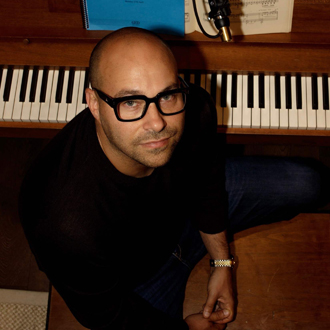
For a full decade, Sam Roman (known as RØMANS) has been a top pop songwriter & producer who’s had several hit songs. He co-wrote Lewis Capaldi’s biggest hit “Someone You Loved,” and he recently had the hit “Good News” with country-pop star, Shaboozey. His songs have also been recorded by Ed Sheeran, Taylor Swift, Rihanna, Pink, Demi Lovato, Alicia Keys and John Legend.
RØMANS is continuing his successful career as a pop hitmaker, but now he is exploring a whole new world of music. He is now an artist who is venturing into classical music. He has signed a label deal with 10K Projects/Atlantic Records and he will be releasing his classical album, Opus 1, on August 28.
With his album Opus 1, RØMANS reimagines orchestral music for a modern audience. Raised on everything from The Beatles and Donny Hathaway to Romantic-era classical music, he blends the emotional immediacy and structure of contemporary songwriting with the scale and depth of cinematic orchestration. He has already released three instrumental pieces from his new album: “Singularlity,” “Ballon” and “Continuum.”
RØMANS grew up in Pinner, Middlesex in England, and he learned to play several instruments at a young age. By the time he was 16, he had signed as an artist to a label development deal. Then a few years later, he signed with Roc Nation and began collaborating with top artists and songwriters. Soon after, he had chart success with Demi Lovato (“Sober”), Jonas Blue (“Mama,” “Rise,” “Polaroid”), Clean Bandit (“Tears”) and Elley Duhe (“Middle of the Night”).
RØMANS also collaborated with Ed Sheeran on the song “The Joker and the Queen,” which appeared on Sheeran’s fifth album. Notably, a duet version of the song featured Taylor Swift.
We are pleased to do this new Q&A interview with RØMANS. He tells how he got started in the music business, and how he co-wrote the hits “Someone You Loved” and “Good News.” He also discussses his new classical album, Opus 1, which he is very excited about.
DK: I read that you’re from Pinner, Middlesex in England. How did you get started with music and learning to play several instruments?
Here’s the video of Lewis Capaldi’s hit “Someone You Loved,”
which was co-written by RØMANS.
RØMANS: Well, I was always quite musical and my mum sort of weaned me on the Beatles, Marvin Gaye and Stevie Wonder, so I had quite a mature, musical upbringing. Then when I went to a school, I was lucky that it had a great music department. I started off as a drummer and I was inspired to learn loads of things, although I wasn’t very academic, which meant that I had a very non-academic approach to learning instruments.
DK: In 2014, you signed with Roc Nation (record label & entertainment company). Can you talk about your early years, working with Roc Nation and starting to have success?
RØMANS: Before that, I had been signed to a development deal straight out of school when I 16, which is why went on this path of chasing a music career. And it was always slightly marred by having to be the artist and actually being quite self-conscious about being in front of cameras and being the voice of a project.
So I got this second shot in 2014—I believe it was meeting the Roc Nation guys and having this opportunity to be an artist thrust upon me again. But I think at the time, and I and because it’s all come full circle now, that I I deflected my discomfort in being at the front and center of the project, by being able to write for other people, And working with Roc Nation and Jay-Z allowed me to open up doors and get access to all these artists, who I then went and collaborated with for their music.
DK: What came first for you in your career, releasing music as an artist or starting to write & produce for other people?
RØMANS: Oh, definitely the artist thing came first, because that was my introduction to the music industry. And the time between being signed as a 16-year-old and being signed as a mid-20-year-old, there was a lot of sitting in my parents’ basement getting high and making beats and writing songs. I used to say, if you came in ninth place or lower in the X-Factor show, you would probably end up at my parents’ basement working with me (laughs).
Here’s the video of Shaboozey’s hit “Good News,” which
was co-written by RØMANS.
I was unsuccessful at the time, but then about a week after signing to Roc Nation, suddenly Kylie Minogue showed up at my parents’ house for a weekend to work with me. And in England, she’s one of our national treasures. It was like going from nothing to having this icon in my basement.
DK: In 2018 you had hit success working with Clean Bandit, Demi Lovato and Jonas Blue. Can you talk about your writing and collaborating with those artists?
RØMANS: I suppose that was my first real experience of financial success as a songwriter. I had started my songwriting career getting cuts with Alicia Keys and Mary J. Blige. But as is the case with a lot of great music, it doesn’t necessarily mean that it’s the music that can pay the bills. So I’d say that was the period when I started looking at what was going on in the U.K., especially with dance music which I had quite an interest in. I had a real love for the style, and it became quite easy. It was a great, fertile time for songwriters. There were so many opportunities, and I would bounce around all these different projects and have a lot of success with them. The Jonas Blue songs, which are not that known to an American audience, were exported to everywhere else in the world. It was a great time.
DK: Then in 2019, you had a big hit with Lewis Capaldi, co-writing “Someone You Loved.” How did you connect with Lewis and write that song?
RØMANS: That was a funny, serendipitous one. I’d met Lewis about two years before that, and he was talking to me early on about wanting to be a songwriter who could write for other people and get a publishing deal. Then a year later, we were in this session and we wrote “Someone You Loved” at the end of a session. I was like a Hail Mary…it was just an incredible moment and it took off from that.
DK: More recently, you had the hit “Good News” with Shaboozey, How did you get together with Shaboozey?
Here’s the video of RØMANS music piece, “Singularity.”
RØMANS: That was a cool one because it was me and a bunch of mates. We did it at my house, and Sean Cook, who’s Shaboozey’s producer, came and joined me, my friend Jake Torrey, and my friend Michael Pollack, who’s actually my next door neighbor. We were just messing around and it was another rare scenario in songwriting where you’re in crunch time, they’re at the end of the album, and they’re looking for the single. And it’s at that point that people are more accepting of something that just feels right. And it was one of those records that felt quite smashy, as we like to say. Everyone’s a bit scared of saying the word, but it was really fluid, and Shaboozey cut it a few days later. It went on to get us a country song of the year nomination at the Grammy Awards, which was great.
DK: Currently, you’re starting to release music from your new album, Opus 1, and it’s quite different. Tell me about your new classical music project, and being an artist again.
RØMANS: It’s a very strange departure and especially because I’ve gone through the process of being an artist before. But I’ve always had a love of classical music and it’s been something that’s stayed with me. I discovered this medium of classical music that felt so true to my taste and what I grew up listening to. And that allowed me to take my ideas and fully explore them, and most importantly for me, to release the type of music that it’s a necessity to have a huge group of humans all playing at the same time. I wanted to make something that relied on the scale of an orchestra and having all these humans moving the air in a room together. It’s such a magical thing and it’s always been my favorite part of a pop project. You know, that one day where you finally get to put the strings on and 40 people pile into the studio.
DK: So for your new album, you brought in an orchestra to play on several of the songs?
RØMANS: I did. It was just a couple of years ago that I learned orchestration and theory, and it’s something that began on my iPad with me sketching out pieces. And it evolved into finally being signed to a record company for the third time in my life and being at AIR Studios in London, which is one of the most incredible studios. And we had 70 of the world’s most talented orchestral players. It was awesome.
Here’s the audio of RØMANS music piece, “Continuum.”
DK: You’ve already released three instrumental pieces, “Singularity,” “Ballon” and “Continuum.” Can you talk about the first release, “Singularity”?
RØMANS: “Singularity” was my equivalent of starting with a bang. I wanted to show a piece that had the full dynamic range of an orchestra in it. And my focus with all of the classical stuff is to use my songwriting experience. I think that most people get scared with the concepts of getting into classical music, and a lot of that is the investment of time that you have to make into listening to some of these pieces.
“Singularity” is an example of a classical piece in a pop template. It’s really like a verse, chorus, verse, chorus, outro. I wanted to do that, but I also wanted to also show the difference really between pianissimo and fortissimo. You know, having everyone playing gracefully and then everyone playing to the absolute exhaustion of their arms and lungs.
DK: With your album Opus 1 coming out soon, do you have plans to play a live show or go on a tour?
RØMANS: Absolutely. It’s very much part of the plans. But I want to redefine what it is to to perform classical music, especially orchestral. And one of the things that sticks in my mind at the moment, is that it’s so difficult to bring people to go and see classical music. Maybe it’s a better idea to bring it to them. So one of the things that we’re doing initially is that we’re actually taking an orchestra into the street in Europe and even giving the public an opportunity to conduct the music themselves. And there will be loads of great opportunities for performance of the music in different capacities. But I love the idea of it becoming a collaborative thing and the idea one day of hosting a concert where the audience can bring their own instruments and play along with the orchestra.