



Grammy-Winning Composer Simon Franglen Talks About His Music Scores For Avatar: Fire And Ash and Avatar: The Way Of Water
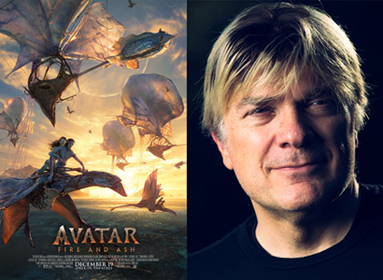
Simon Franglen is an award-winning movie composer, songwriter, producer and musician, who has emerged as a top composer and musician for some of the biggest box office hits of all time. He has become known for composing the music scores for director James Cameron’s blockbuster films: the new Avatar: Fire and Ash, and Avatar: The Way of Water. He has also contributed music to many other movies including Avatar, Titanic, Dances With Wolves, The Bodyguard and Moulin Rouge.
For much of the past seven years, Franglen has devoted his time to working with Cameron on the music for both Avatar: The Way of Water (released in 2022) and Avatar: Fire and Ash (released in December 2025). Unlike most movie projects, where the composer is brought in near the end of filming to create the music score, Franglen worked with Cameron throughout the filmmaking process. This is because Cameron places great emphasis on the music in his films, and he wants the music to be composed simultaneously with the filming, with some scenes written prior to filming.
The scale of the Avatar: Fire and Ash music production was as epic as the film. More than 210 musicians and singers contributed, including a 100-piece orchestra, large choirs, small vocal ensembles from the Pacific Islands, solo vocalists and instrumentalists, extensive percussion, and custom synthesizer programming by Franglen. And notably for this film, Franglen co-wrote the end title song, “Dream As One,” which was performed and co-written by Miley Cyrus.
It was in 2017 that Cameron met with Franglen, and proposed the idea of Franglen composing the music score for several Avatar movies that he was planning. Cameron had been impressed with Franglen’s collaboration with composer James Horner on the first Avatar movie (released in 2009). And following Horner’s death in 2015 (from a plane crash), Cameron wanted Franglen to take over the music scoring for all the remaining Avatar films (including a possible Avatar 4 and Avatar 5).
Franglen, who is from London, England, first had success as a musician in the late 1980s, when he became known as a talented keyboard player and synclavier programmer. He subsequently moved to Los Angeles and was a synclavier programmer for top record producers such as Quincy Jones and David Foster, and he worked on hit records for Whitney Houston, Michael Jackson, Eric Clapton, Toni Braxton and other artists.
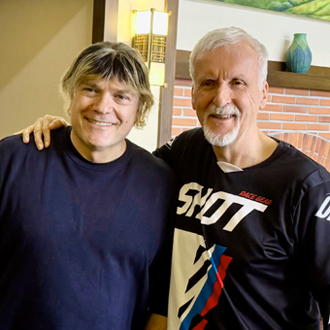
After establishing himself in the music business, he also began working with several movie composers for their music scores. He collaborated with John Barry, Alan Silvestri and Howard Shaw, and helped them create music for Dancing with Wolves, The Bodyguard, Chaplin, Moulin Rouge and Seven.
It was around 1992 that Franglen met top composer James Horner, and remarkably their first project together was Titanic. Notably, Franglen co-produced the Celine Dion hit “My Heart Will Go On” for Titanic, for which he won a Grammy Award.
Years later, Horner showed Franglen some footage of a new James Cameron film that would be called Avatar. Franglen was amazed by the footage, and he then spent a full year working with Horner on this film.
We are pleased to do this special Q&A interview with Simon Franglen. He talks about the making of the three Avatar movies, and how he works with James Cameron. He also discusses the early years of his career, and the many films he has written music for.
DK: I read that you grew up in London, and in the late ‘80s and early ‘90s you played keyboards and did synclavier programming on several hit songs. Can you talk about this early part of your career?
Simon Franglen: My first big gig was working for record producer Trevor Horn (who produced Seal and Yes). I was in England and I was a synclavier programmer, and synclavier was like the first big music computer. I did that, and then I went out on my own as a record producer and as a songwriter. I started doing records in England and did some jingles for TV. At some point I was asked to work with a great American engineer & producer named Humberto Gatica who worked with Quincy Jones. He told me, “Nobody programs like you in America. You should come to L.A.” So I flew out to L.A. and it was like…”Oh, I better go back to school. This is a whole other level.” So I went from being a record producer (in the U.K.) back to being a programmer, and I started working with (hit writer & producer) David Foster.
David and I hit it off, and we had a very successful period working together. He is a phenomenal keyboard player, arranger & producer, but maybe I brought a slight edge to his sound. I would do all the rhythmic side of things…all the drums and so on. David would play a guide piano or a Rhodes piano, then I’d do a load of rhythm stuff. Then we would split up the other bits of the record together…the strings and the other keyboards.
Here’s video of Simon Franglen discussing his music score
for Avatar: Fire and Ash.
The first big thing we did was The Bodyguard soundtrack and the Whitney Houston songs. From there, we seemed to have a ridiculous run of success in the ‘90s, working with Michael Jackson and Quincy Jones and many other artists. And because there was often an overlap, I started working with film composer John Barry, and then I worked with Alan Silvestri, Howard Shaw, and eventually James Horner. This was the two worlds of records and films combined, because I also produced (Celine Dion’s hit) “My Heart Will Go On” for Titanic. So that was the evolution of my work.
DK: What films did you work with John Barry on?
Franglen: I first worked with John on the very end of Dances with Wolves which he won an Oscar for, and then Chaplin was the next big project. We did several other movies, and we became very close friends. He was astonishingly good at understanding the emotional impact that music could have in a film, and that’s something I hope I carry with me today.
DK: You later began working with James Horner. How did you first connect with James, and what made the two of you such a great team?
Franglen: The first thing I did with James was Titanic. I was working with Alan Silvestri on a film called Contact, and Alan and James have the same agent. The agent phoned me and said, “Look, there’s a problem with this film (Titanic). This film is gonna be a disaster. They have no money. There’s no money for music.” And I was the guy that could make synthesizers and samples into these hybrid orchestral instruments and stuff that I’ve done. I was known for being able to do things with them that other people couldn’t do. So they asked me to work on outlining some demos for Titanic, and those demos ended up in the film. And because we had no money, we didn’t have enough money for an orchestra throughout the film. So about two-thirds of the soundtrack of Titanic is only synthesizers. Even though it sounds big and epic, we had a limited budget.
After Titanic, I moved back to England for family reasons. It was a couple years later when I was working on Moulin Rouge, that I bumped into James at a studio and then Avatar happened. James said, “Look, come and have a look at five minutes of this film (Avatar). When I saw it, I said “this is the most amazing thing.” And he said, “Well, would you do a week?” I said “Okay.” So we tried a week doing Avatar, and then that became a month, and then that became a year. And we realized that we had a great working relationship. We had a rhythm, and it was something that I was given this job title of being electronic music arranger for Avatar 1. Which meant that the things that weren’t orchestral, I did. James did the big orchestral stuff, and I did the glowing forest and all the textures of Pandora.
Here’s the trailer of Avatar: Fire and Ash.
There was so much stuff to do there…I was building the sounds and feelings of Avatar. I enjoyed working with James; he became a very close friend, and I enjoyed working with the team. So we started working on all the films after that. I moved into this role called Score Producer, which I’d oversee producing the scores and sorting them all out in terms of delivering the scores. And we were starting to work on three films. At one point we had started The Magnificent Seven, The Great Wall and Hacksaw Ridge.
Around this time, while we were working on The Magnificent Seven, James flew back to Los Angeles. He was a very experienced pilot, but unfortunately he died in a plane crash in the middle of 2015.
I had also been working on the new Avatar ride for the Disney World theme park, for which I had to deliver five hours of music. So Jim Cameron and Jon Landau (the producer of Avatar) asked me to continue working on the music for the ride, and that went through to the summer of 2017. And Antoine Fuqua, who was the director of The Magnificent Seven, asked me to deliver the score for The Magnificent Seven, so I finished that score. Then in early 2018, Jim Cameron asked me to read the scripts for Avatar 2, Avatar 3, Avatar 4 amd Avatar 5. Then we started working on Avatar 2 and Avatar 3. So it’s been a journey.
DK: You said that you and James Horner spent a year working on the music for Avatar 1, which seemed a long time. This is because on most film projects, the director usually would shoot the film and then towards the end of the project, they would bring in a composer who would complete the score within a few weeks or months. But you spent a year doing Avatar 1. So yout approach on Avatar with James Cameron is quite different from working on most film projects.
Franglen: Yes, 95% of the films that I would do as a composer, I come in at the very end of the project, and I’ve done film scores in two weeks, or two months. It’s not uncommon. The difference with the Avatar films, is that there is often stuff that has to be done on screen. And so we have to have music ready before they shoot the film. That’s the first thing. The second thing is, he expects me to take the time and effort that he does on every visual, and he requires a lot more music than than most films. On Avatar 3, I have over three hours of music in the film. That’s four times as much music as most films. And that requires a lot more heavy lifting. It’s also extremely complex music in terms of requiring a lot of different things. And it’s something that he requires me to take the care. For Avatar: Fire and Ash it’s been two-and-a-half years of solid writing.
Here’s the video of “Dream As One,” performed by Miley Cyrus.
DK: So when you started working on Avatar: The Way of Water around 2017, did that take two or three years?
Franglen: Yes. We intended to start the scoring in early 2020, but then Covid hit. So it ended up being about two years of working on that.
DK: When in 2017, James Cameron said, “Here are my ideas for Avatar 2, 3, 4 and 5,” and he wanted you to do all these films, were you thinking, “Oh my goodness, this is the next 10 years of my life doing this?”
Franglen: Oh yeah, that was the requirement. They said to me, “If you want to do this, you have to do all of them. The deal was…I had to sign for all four films.
On the other hand, it is Avatar, and I think that’s the thing—it’s a very special, unique project, and it’s something that I’m very proud of, the work that I’ve done.
DK: I recently saw Avatar: Fire and Ash, and I thought the movie and your music was excellent. For you as the composer, are there two or three special scenes in the movie that you’re really proud of?
Franglen: Yes, there’s a couple of bits I’m extremely proud of. I’m proud of what’s called “I Am The Fire” on the album. It’s the music when Varang (played by Oona Chaplin), our new super baddie, and Quaritch (Stephen Lang) are in the hut together. And that whole sequence is from the point when Quaritch arrives in the Ash Village to the end, the eight or nine minutes build. It goes all over the shop from experimental orchestral to hardcore electronic. It has so many different textures. It was a very complex score, a cue to do. Another one is called “Sacrifice.” It’s when Jake and Spider are in the forest together. And that again, I’m extremely proud of. I think it emotionally fits.
Then there’s “The Windtraders,” which is a big epic theme that everybody seems to be liking, which I’m proud of. And there’s a very small cue called “You Said You Could Protect Us,” which is tiny, but is incredibly bound into the dialogue of a very small scene.
DK: The movie climaxes in the last 45 minutes of the film, where there’s a lot of action and drama. As the composer, are all scenes equally challenging to do, or is there an added emphasis in the climax, where you know the last 45 minutes need to be powerful?
Here’s the trailer of Avatar: The Way of Water.
Franglen: Oh I know that there are these enormous action sequences. It’s always very tough; I have to craft that very carefully. It’s so much music to write. If you think about this, if you have a bar of music at 75 beats per minute, or instead you’re at 150 beats and you’ve got two bars for every one. So say you have a 5-minute cue. Well, a 5-minute cue at 75, it might be 150 bars. And if it’s at twice the speed, you’ve got 300 bars of music just for that five minutes. So that action sequence is probably 2000 bars of music.
DK: You also wrote the end title song, “Dream As One,” which is performed by Miley Cyrus. How did you write that song with Miley, Mark Ronson and Andrew Wyatt?
Franglen: Jim Cameron asked me, “Do you think Miley Cyrus would be a good fit for the end title song? We were talking about the song and I’d already come up with a title, which I wanted to call it, ”We Dream As One.” And I knew Mark Ronson and Andrew Wyatt…we’re friends. I phoned up Andrew and said, “Do you think Miley would be interested?” And he texted me back within 10 minutes and she said. “Yes.” So they came to see the movie in LA., and then they came to my studio and we spent some time going through themes. I gave them some ideas, and then I had to go to New Zealand to continue working on the film with Jim. They started getting ideas together with Miley and they would send me stuff. I would then send them ideas back. So we ended up writing the song, and then I finished it off to get it into the show. It felt right the way it feels in the film. I’m very proud of it and pleased with what we ended up with.
DK: Simon, you have devoted a lot of time to composing the music for the Avatar movies. Do you also have time to take on some new film projects that are separate from the Avatar films?
Franglen: Yes, I’ve probably got a couple of years before I ever get back into Avatar 4, if it exists. So I’ve got some other things to do this year and we’ll be fine. I’m very much looking forward to doing something different.

- Rising Hit Artist Em Beihold Talks About Her Excellent Debut Album, Tales Of A Failed Shapeshifter, And Her Songwriting - February 25, 2026
- Chris Landi’s “Get On Up” Named February “Best Song Of The Month” - February 11, 2026
- Special Interview With Teddy Riley, Legendary R&B/Pop Writer/Producer And Inductee Into The Songwriters Hall Of Fame - June 1, 2023
