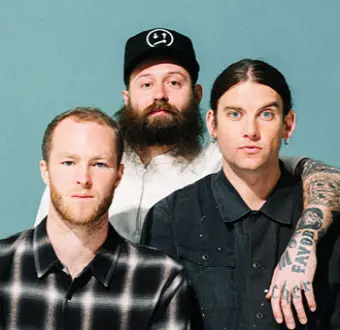
During the past five years, alternative folk/rock trio Judah & the Lion has emerged as a popular band that is building a large following, and having hit success. Led by singer & guitarist Judah Akers, the band uniquely features a mandolin player (Brian Macdonald) and a banjo player (Nate Zuercher) as the other key members.
Judah & the Lion are known for writing and recording high-energy anthemic songs, that often have a positive, uplifting outlook. Their biggest song to date is “Take It All Back” (released in 2016), which was certified platinum and reached #1 on Billboard’s Alternative Airplay chart.
The trio has just released a new EP called Spirit (on Cletus Van/Virgin Records), which includes their latest single “Spirit” plus four remixes, that range from acoustic to experimental pop. This song has a heartfelt lyric about not giving up, and the music builds to a powerful, emotional peak in the chorus.
|
Based in Nashville, Judah & the Lion was formed in 2011, when Akers met Macdonald and Zuercher at Belmont University. They were all focused on music, and Akers was pleased to start a band and collaborate with talented musicians Macdonald and Zuercher.
Besides the single “Take It All Back,” the trio has also enjoyed radio chart success with their songs “Suit and Jacket” (which went gold in 2017), “Over My Head,” “Why Did You Run?” and their recent single, “Beautiful Anyway.” Notably, the group also released an excellent duet ballad called “Pictures” that featured Grammy-winning artist, Kacey Musgraves. In addition, they’ve released three albums: Kids These Days (2014), Folk Hop n’ Roll (2016) and Pep Talks (2019).
DK: When you were starting out, how did you, Brian (Macdonald) and Nate (Zuercher) form Judah & the Lion?
Here’s the lyric video of Judah & the Lion’s single, “Spirit.”
Judah Akers: We all met at school, at Belmont University in Nashville. At the time, I was in my junior year…I was writing songs but I hadn’t recorded them. Then I went back home for the summer, and my mom overheard me play and said, “Why aren’t you recording these songs?” And I said, “I don’t know if they’re good enough yet.” Then she said, “Well, nothing’s ever good enough until you try.”
At Belmont, we had access to these amazing studios for free as students. So the next semester, I talked to Nate, who was the only banjo major at Belmont. And I was like, “Hey, I have these songs written and I think they’re good. I want to record them for me to have, and so I can play them for my mom” (laughs). Then Nate said, “I’ll come and jam with you.” And I was like, “If you know anybody that you’ve been playing with, that instrumentally you think they would work, invite them along to play.”
Nate was friends with Brian, who was the only mandolin major at Belmont. They were in these ensembles playing bluegrass music. Then we went to lunch—we had a lot in common and we played these songs in the Bell Tower (at Belmont), just jamming out. And the next thing you know, we were recording. Then they approached me and said, “Hey, we really believe in this music and we want to make a band of it.” So we were kind of off to the races.
DK: It’s unique to feature a mandolin player and a banjo player. Did you have a vision that this musical combination would work well?
Judah: To be honest, we didn’t have a clue to what we were doing (laughs). I loved writing songs, and they were very skilled musicians. I had just picked up a guitar a few years back. So I was fairly new to playing guitar, and if you’re in Nashville at Belmont, the next person is way more talented than you are. It was fortunate for our band that we had a little bit of ignorance, because we were like, “Let’s form a band—that sounds like fun.” And suddenly you’re in a business together, and you’re making bigger decisions.
For me, I grew up in Cookeville, Tennessee. I was always around bluegrass music, growing up in a rural town. So on that day when we played at the Bell Tower, it felt super-natural and organic. And the way our group grew from there has felt very grassroots. I’m very thankful that the band came to fruition.
Here’s the video of Judah & the Lion’s single, “Beautiful Anyway.”
DK: Many of your songs have a lot of energy with an uplifting spirit. When you and the band write the songs, do you try to look at the positive side?
Judah: For me, I’m a natural optimist. I think authenticity is looking at the pain and sadness, and trying to choose hope and choose life at the end of the day. Because I think the lie about optimistic people is that they’re always happy. That’s not really true, at least in my case. I think dealing with sadness and depression and anger is very common [as part of] my personality as an optimist. We’ve always wanted our music to reflect the reality of the pain and sadness, but also choose to be a person that is filled with hope and love and light.
When we’re playing live and singing songs with people at our shows, I think it comes to an energetic feeling that we want to come across with. And we also want to write songs that bring a little light to the heaviness of the world that we live in. That’s always been our motive.
DK: In 2016, your had a breakthrough hit with “Take It All Back.” Can you tell the story behind that song?
Judah: That was so funny, because some songs take five years to write, and other songs take 30 seconds. And “Take It All Back” was written in a shed in about 30 seconds. Nate had this banjo line, and then me and Brian were vamping on that, and I came up with the lyrics and the melodies. It was almost arranged and finished in a matter of minutes. And it came from the spot where a lot was happening to the band at the time.
We had just played the David Letterman Show, and that was a weird thing for us. At the time, we were an indie bluegrass/folk band, and David Letterman’s team liked one of the songs on our first record. Then we played the show and it was amazing. You know, our parents finally took us seriously (laughs). That moment was beautiful, but it was gone really quickly. And we wanted our band to be more than just some great moments. We wanted to make this about people. When we’re saying, “Take It All Back,” it comes from this heart, that no matter if we play small shows or big shows or play the Letterman show, we want to make this about people. We want to connect with people.
DK: You’ve just released a new EP with your song “Spirit,” and it contains other mixes of the song. What inspired you to write this song?
Here’s the video of Judah & the Lion’s hit, “Take It All Back.”
Judah: That song came right before Covid happened…it was the fall of 2019. Part of our last record (Pep Talks) was about my journey through my parents’ pretty explosive divorce, and my depression and anxiety going through that. It was coping in some good ways and bad ways. And I thought…everybody’s journey is kind of linear. If you don’t go through stuff as a human…nobody’s life is perfect all the time. And with the song “Spirit,” we had this journey of…there’s no poem that’s perfect, no story that’s perfect, but you keep moving forward no matter what.
It’s weird right now, not being able to play “Spirit” live yet at shows. But in the meantime, we thought it would be fun to do new mixes, to have a couple friends rethink the song and put their print on our words and melodies. So that’s why we had the idea of coming out with an acoustic version, and then these bigger mixes that were more pop or indie.
DK: I was listening to your songs, and one that stands out is “Suit and Jacket.” It has a powerful lyric about not wanting to grow old too quickly. What inspired you to write this song?
Akers: It’s funny about that one. Unlike “Take It All Back” which took about 30 seconds to write, “Suit and Jacket” took me about five years to write. I had been at a wedding early on in our career. A friend’s uncle came up to me and said, “When are you going to start taking your life more seriously?” Like stop playing music in a band and get more security. At the time, I took offense to that comment, that he didn’t believe in our music career. So I came up with that line, “I ain’t trading my youth for no suit and jacket, I ain’t trading my dreams for no 401-K.”
Then fast forward to a few years later, my grandpa passed away suddenly. And the song was written in the context that my grandpa really believed in my dreams and in my creativity. I wrote that song for him believing in me, and saying that sometimes in life when you see friends get to that next chapter quicker than what I was doing, I wrote it from this place of…I don’t want to grow old. I want to pursue my dreams and figure out where I’m going.
Here’s the video of Judah & the Lion’s song, “Pictures,”
feat. Kacey Musgraves.
DK: Another song I like is your ballad “Pictures,” with Kacey Musgraves. How did you and Kacey connect for this song?
Akers: That was a really fun thing to get to do. Kacey has been a hero of ours for a while. Again, a lot of Pep Talks was about me going through my parents’ divorce. I was in the middle of that, and I called my mom, and we had an emotional moment. After the call I was so emotional, and I picked up the guitar and wrote that song from the perspective of my parents. So we really wanted to have a powerful figure to sing it, and I said to the guys, “If there was any way we could get Kacey Musgraves, that would be perfect.” And it was so awesome. She heard the song and liked the story behind it. And she sang the song from my mom’s perspective. She was such a great, brilliant artist in the studio…it was inspiring. It was really cool to connect and sing a duet with her.
Here’s the link to Judan & The Lion’s site: https://www.judahandthelion.com/