
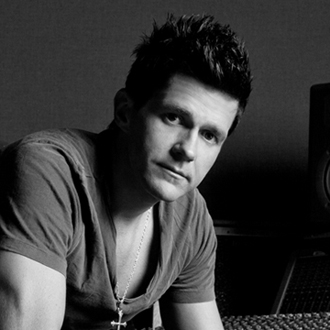
It takes many people to help elevate a singer to the level of major country star, and for Luke Bryan one of the key players is Michael Carter. A longtime friend, Carter is also Bryan’s lead guitarist, band leader, and the songwriter behind 12 of Bryan’s songs including the hit “Roller Coaster” and the current Top 5 single, “Move.” Carter penned “Roller Coaster” with Cole Swindell, and the two men also co-wrote several more hits, including Craig Campbell’s “Outta My Head,” Thomas Rhett’s “Get Me Some of That,” and Swindell’s “Hope You Get Lonely Tonight.” In addition, Carter produced Swindell’s debut album.
Bryan and Carter met 21 years ago and started playing frat parties in a band together in college, and the two never separated as they moved from small gigs to major stadiums.
“It sure beats pulling a U-Haul and a van; I can tell you that!” Carter gladly admits of his escalating success with Bryan. “Every year it just keeps getting better and more things keep happening. It’s really hard to describe. Every now and then you have to take a step back and think…this is unreal.”
We are pleased to present this new interview with Michael Carter, whom we talked to on the phone, while he was in the dressing room at Detroit Lions Stadium on the last date of Bryan’s headlining tour, Kill The Lights Tour. He talks with us about working for one of country music’s top stars, the story behind some of his top tunes, having the right mindset to make it as a songwriter, and the tune that Florida Georgia Line let slip away.
BC: Congratulations on your latest chart success, “Move,” for Luke Bryan. How did that song come together?
Michael Carter: The idea Luke had was the spelling out of [the theme] move. It kind of went from there and led into a story. We tried to figure out what kind of story you’re going to paint for somebody besides having a chorus about a guy being all mesmerized by a girl dancer. We came up with the idea of a new girl moves to town. Sometimes you see a movie and somebody comes to town and falls in a bad crowd. We figured this might be that somebody moves to town and they fall in with a good crowd, come out of their shell a little bit and let loose. It kind of went from there.
BC: How did you and Luke meet?
Carter: We met in Darton State College in Albany, Georgia in 1995. I’m from a small town that’s east of there, and he’s from a small town that’s north of there. A buddy that was older than me introduced us. He had a band going and I got in it then, and I’ve been in it ever since. We just hit it off and been best friends ever since. Eventually, we went off to Georgia Southern (University) at the same time and really got the band going and played all around the South, mainly Georgia.
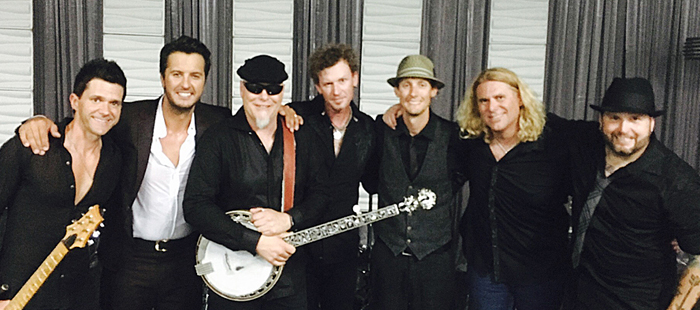
When we first met, we kind of made a little pact that no matter what happened with the band or in life we would find our way to Nashville. It was one of those things where I was the nerdy guy that was serious in high school. [I said] We need to practice! I was trying to find something that would stick. I knew that was what I wanted to do, but how do you go about it? We met and ‘Ah!’ Here’s a guy that’s just as into it as I am. I knew he was crazy talented, and we had so much in common. There have been a lot of ups and downs. A lot of life lived in those 20-something years. I sure am appreciative, and it’s really surreal to do what we’re doing.
BC: What is your typical day like as the band leader?
Carter: It depends on what level you’re at as to how much you might have to do or not do. Traditionally, what a band leader’s done is be the go-between the artist and management and the band. They’re kind of the point person if something needs to be done musically, organizationally, and just making sure the band understands everything that’s going on—the schedule, the times, places, the material. For us out here, I’m kind of the liaison with us and the union, the record label, when we do TV stuff, keeping track and making sure everybody gets paid and that everything is documented.
We’ve actually been on tours where we’ve seen another artist rarely talk to the band. He’ll tell the band leader what he wants, and the band leader passes it along. That’s never been what we’ve been a part of. It’s more of an all-on-one-team deal.
Out here it might be a little more on me to try to come up with new ways to play songs that we’ve played for a long time or new ways to put songs together. It can be all sorts of duties. Making sure everybody knows where they’re supposed to be on the bus, or when we’re supposed to be in the lobby or sound check.

BC: You’ve done really well as a songwriter too. How does the songwriting process work for you?
Carter: Some people have a specific deal the way they go about it. For me sometimes, it’s about who you’re in a room with. When you’re writing with an artist, especially an established artist like a Luke or a Cole (Swindell), somebody needs to kind of run the room and direct the traffic, so to speak. You can’t really have three people or two people in charge. So, if you’re writing with an artist, you might come with an idea or something, but if they have an idea, you need to roll with that because they’re the ones who have to sing it. They have to say it and be comfortable with it. A lot of times in that scenario, it’s just trying to come up with a good groove and good melody.
I’m more of a write-with-an-acoustic-guitar kind of guy. There are some guys now that you kind of write in a studio or they may have a beat going, or they can create a track as you’re going. That works good too. But I like just banging around on a guitar and maybe coming up with a guitar part or progression.
It seems to be different every day, which is cool. I have an idea that just hit me, and I write it down and I think this idea is something we want to write with this guy and this girl because I really think it will fit them. Sometimes you go into a room with nothing. If you’re kind of burned out or tired getting off the bus and going to a write, you think, “Boy, do I have anything to offer?” Just get in there and start banging around on chords and stuff and see what happens.
I try to learn and continuously learn and to not be the one-trick kind of deal—in other words, not just lyrics, not just melody, not just the musical part. You get a sense of pride when something works like “Move,” and you feel like you’ve got your fingerprints all in the song.
Here’s the video of Luke Bryan’s hit, “Move,” which was
co-written by Michael Carter.
BC: You produce Cole Swindell, who used to work merchandise on the road for Luke Bryan. Did you know him before then?
Carter: Cole split his time growing up in two areas of Georgia, but one of them is right near where Luke and I grew up. We didn’t know him—we’re older than him. We graduated and were coming back there [to college] to keep playing on the weekends, and that’s where we met Cole. He had been going to school there, and he was in the same fraternity. He was singing with one of his buddies. He and Luke hit it off. Cole moved up and decided to come on the road selling ‘merch.’
We just got on a tear where we would spend the afternoons, if we didn’t play ‘til late, writing in the back lounge. We were all on one bus. There’s luggage and stuff everywhere. You’re sitting on top of everybody’s stuff trying to find somewhere to make a little racket, trying to come up with something.
We got to writing some stuff that I think Luke started liking and taking an interest in. Then, the three of us started writing pretty regular and were fortunate enough to have songs between the three of us. Cole and I both signed with Sony/ATV Publishing at the same time and did a joint venture with Luke on that. We wrote all the time. Eventually, Cole got off the road and was writing fulltime. We would demo songs. I didn’t realize that’s what a producer does, and I didn’t really have any ambition of moving to town to do that. He and I are on the same wavelength musically. It took a long time, and then all of a sudden it just happened really quickly.
BC: Tell me about the hit “Hope You Get Lonely Tonight” that you and Cole helped co-write.
Carter: That came about a couple of years ago. We had a tour where Florida Georgia Line was the opening act, and Thompson Square was the middle act. There was a stretch where Keifer (Thompson) from Thompson Square ran into some out-of-nowhere freakish vocal trouble with his vocal chords and lost his voice. They had to take almost a month off. So, Cole came out and became the opening act and Florida Georgia Line became the middle act for that month. One day we all decided to get together and write, meaning Cole and I and Tyler [Hubbard] and Brian [Kelley] from Florida Georgia. Brian had this idea called “Hope You Get Lonely Tonight” and he told Cole that morning. I think some ex-girlfriend or something from high school or someone back home had written him on Facebook and used that phrase. He told us, and we were, “Oh, yeah! That’s awesome.” He had one of those Bluetooth speakers that you can hook up to your phone and he had a little beat going. The four of us sat down. It was like an hour and we wrote it. Then, the rest of the day we’re playing [our work tape] for everybody. We ended up demoing it. It coincided about the time when Cole was getting his record deal, and we were about to cut the record. They (Florida Georgia Line) were like, “Man, you all got ahead and cut it. We’re in between album cycles.” It ended up being a great song for Cole.
Here’s the video of Cole Swindell’s hit, “Hope You Get Lonely Tonight,”
which was co-written by Michael Carter.
BC: How did Craig Campbell’s hit “Outta My Head” develop?
Carter: Cole and I used to have a standing writing session every week between he and I and Brandon Kinney—who’s one of our really great friends and a tremendous writer—before we got so busy on the road, and Cole got his own schedule on the road. We were in this little bitty room that Brandon liked to write in that’s in a secondary building for Sony called The Fire Hall. We called it “Kinney’s closet” because it was about the size of a closet, and it didn’t have any windows. He always wanted to write in there. Because every other room had windows, his theory was if it’s raining or looks kind of gloomy and cloudy outside, then it won’t affect you because you won’t see it. It’s the same every day no matter what. We’ve been blessed to have several cuts together between the three of us.
That was like our first big cut that I had. Craig played keyboard for us back when we were still in Luke’s suburban, dragging a U-Haul. I think we were in an Elk Lodge back in Georgia playing, and Luke asked, “Hey dude, do you want to sing a song?” And he starts singing, and we looked at each other like, “My God! Who is this!” He just had this big, big country voice. Luke kind of shoved him out the door and said, “Man, you need to be on the radio. You don’t need to be out here playing with me. You need to do your own thing.”
To have Craig text us and go, “Hey, someone played that song, ‘Outta My Head’ and I love it.” We were flipping out. He was a buddy of all of ours. He’s such a great guy. It was such a long slow move up the chart. Craig was still trying to break as an artist, and it stayed on for 50-something weeks. Man, it was awesome to get to write that with two great buddies, and then have another buddy cut it, take it out there and give it some life.
I want more of these. I want to see that again. It’s kind of the cool, never-ending story where one makes you hungrier for the next one. I’m going to keep after it and keep being thankful and try to come up with another one.
BC: Do you have any advice for songwriters?
Carter: If you want to make it as a songwriter in Nashville, you’ve got to move to Nashville and go all-out committed to do it. That means you’re probably going to starve for a little bit. It’s all part of the process, figuring out how to make ends meet and still write songs. In all that living of the ups and downs, that journey helps you to write.
Here’s the video of Thomas Rhett’s hit, “Get Me Some Of That,”
which was co-written by Michael Carter.
Repetition (keep writing songs). I remember Luke telling me. You just have to write them and move on. Write the bad ones and write your way through the bad ones and learn from it.
One of the biggest things, is getting into Nashville and meeting people that have the same mindset that you do. In other words, people who had a really safe, normal life/career, stable environment, and gave all of it up to throw caution to the wind and chase the thing that everybody says you’ll never get to do. Your odds are so far you might not make it; you’ll fall on your face.
When you get around other people who think that same way, it’s really inspiring. You get around other people whose mind works creatively. They’re quirky, but they like sitting around and just coming up with stuff.
It takes a lot of luck and being hard-headed, I guess. There are other people that are artists now, successful writers now, that kind of came up when I did. We were all broke, and we were all one sandwich to the next, but just having a ball because that’s what you always wanted to do. That’s your key. If you can do that, then you’ll be great! Actually, being able to keep your head above water and make a living in music is a bonus to me.
Bill Conger is a freelance writer for various publications including Bluegrass Unlimited, ParentLife, Homecoming, and Singing News and is currently writing a biography on The Osborne Brothers with Bobby Osborne. He can be reached at billofwrites2@yahoo.com. He is also on Google+